Research Summaries

By Reesha M. K. Sidhu
References
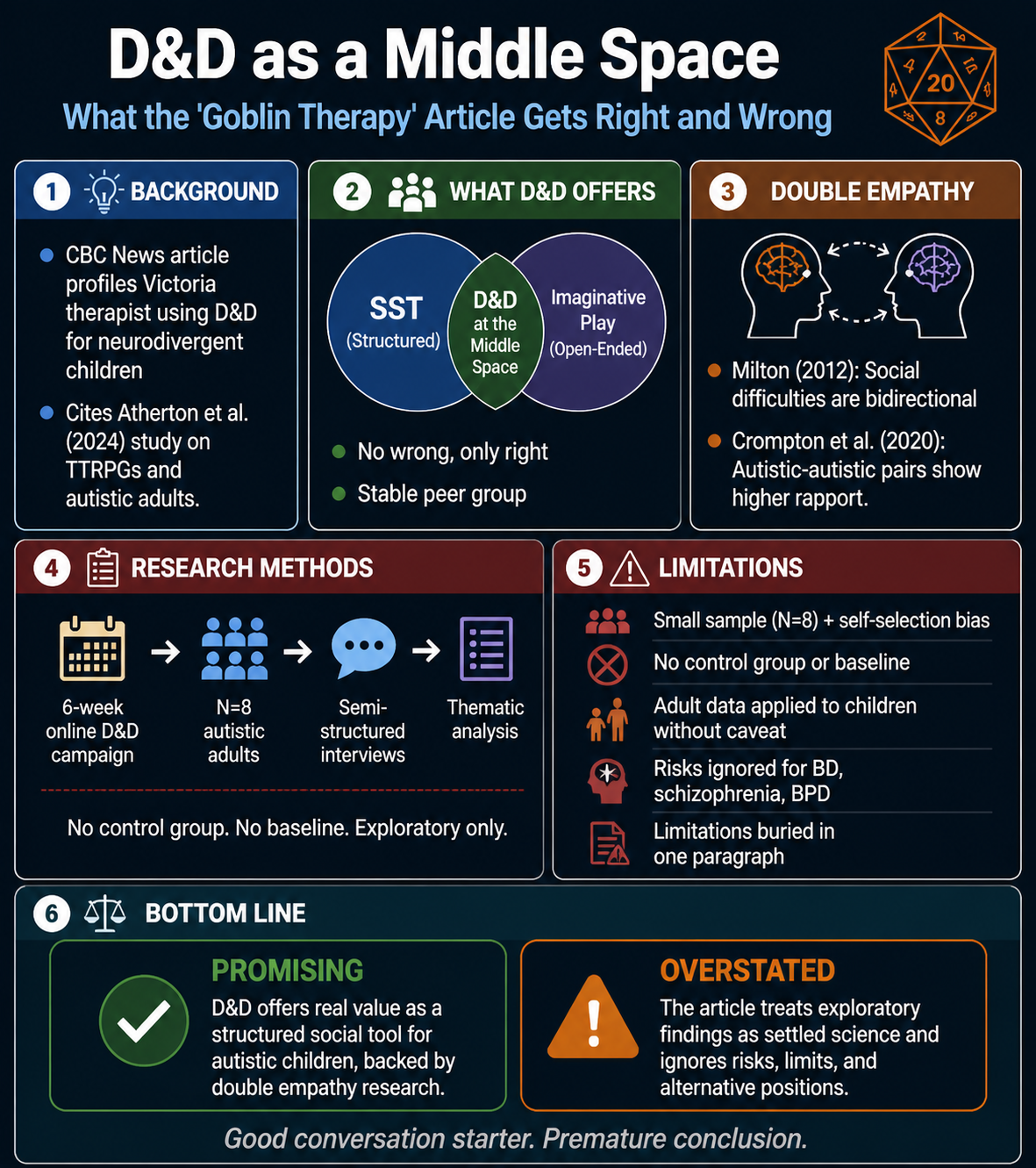
Atherton, G., Hathaway, R., Visuri, I., & Cross, L. (2025). A Critical Hit: Dungeons and Dragons as a Buff for Autistic People. Autism, 29(2), 382-394. https://doi.org/10.1177/13623613241275260
Crompton, C. J., Sharp, M., Axbey, H., Fletcher-Watson, S., Flynn, E., & Ropar, D. (2020). Neurotype-Matching, But Not Being Autistic, Influences Self and Observer Ratings of Interpersonal Rapport. Frontiers in Psychology, 11, Article 586171. https://doi.org/10.3389/fpsyg.2020.586171
Little, S. (2026, May 2). Goblin Therapy: B.C. Researcher Taps Magic of Dungeons & Dragons to Help Kids. CBC News. https://www.cbc.ca/news/canada/british-columbia/dungeons-and-dragons-kids-therapy-neurodivergence-9.7178879
Milton, D. E. M. (2012). On the Ontological Status of Autism: the "Double Empathy Problem." Disability & Society, 27(6), 883-887. https://doi.org/10.1080/09687599.2012.710008
By Reesha M. K. Sidhu
References
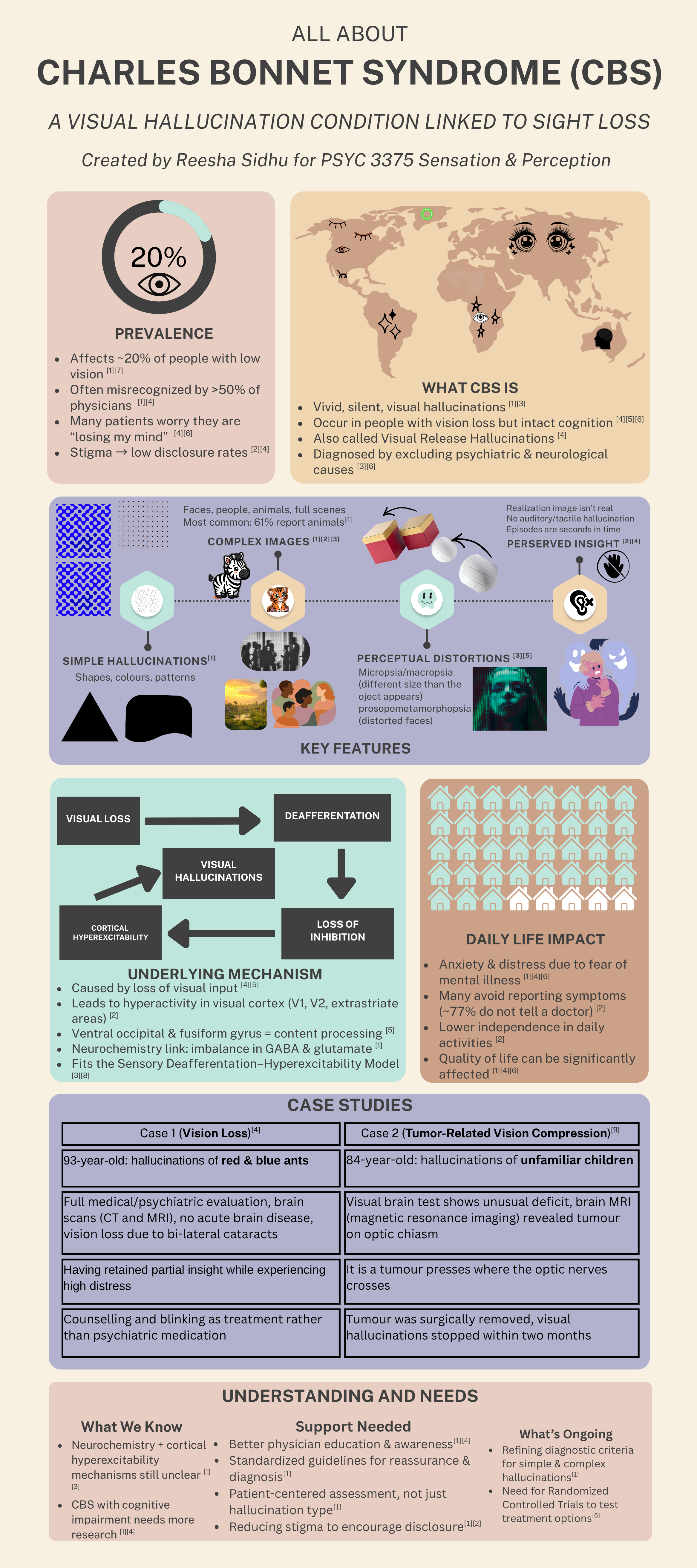
Jones, L., Jolly, J. K., Potts, J., Callaghan, T., Fisher, K., Ip, I. B., Bridge, H., Walker, R. & Moosajee, M. (2025). From research to action: Recommendations for charles bonnet syndrome care and policy. BMJ Open Ophthalmology, 10(1), e002009. https://doi.org/10.1136/bmjophth-2024-002009 [1] Christoph, S. E. G., Boden, K. T., Pütz, A., Januschowski, K., Siegel, R., Seitz, B., Szurman, P. & Schulz, A. (2024). Epidemiology and phenomenology of the charles bonnet syndrome in low-vision patients. International Ophthalmology, 44(1). https://doi.org/10.1007/s10792-024- 03298-0 [2] Vale, T. C., Fernandes, L. C. & Caramelli, P. (2014). Charles bonnet syndrome: Characteristics of its visual hallucinations and differential diagnosis. Arquivos de Neuro-Psiquiatria, 72(5), 333-336. https://doi.org/10.1590/0004-282X20140015 [3] Kelson, M., Santos, T., Athanasios, A. & Fitzsimmons, A. (2022). Out of sight, am i losing my mind? a case report on visual release hallucinations – charles bonnet syndrome. Psychiatry Research Case Reports, 1(2), 100036. https://doi.org/10.1016/j.psycr.2022.100036 [4] Brucki, S. M. D., Takada, L. T. & Nitrini, R. (2009). Charles bonnet syndrome: Case series. Dementia & Neuropsychologia, 3(1), 61-67. https://doi.org/10.1590/S1980-57642009DN30100012 [5] Doeller, B., Kratochwil, M., Sifari, L., Hirnschall, N. & Findl, O. (2021). Benefit of psychiatric evaluation on anxiety in patients with charles bonnet syndrome. BMJ Open Ophthalmology, 6(1), e000463. https://doi.org/10.1136/bmjophth-2020-000463 [6] Subhi, Y., Nielsen, M. A., Scott, D. A. R., Holm, L. M. & Singh, A. (2022). Prevalence of charles bonnet syndrome in low vision: A systematic review and meta-analysis. Annals of Eye Science, 7, 12-12. https://doi.org/10.21037/aes-21-37 [7] O'Brien, J., Taylor, J. P., Ballard, C., Barker, R. A., Bradley, C., Burns, A., Collerton, D., Dave, S., Dudley, R., Francis, P., Gibbons, A., Harris, K., Lawrence, V., Leroi, I., McKeith, I., Michaelides, M., Naik, C., O'Callaghan, C., Olsen, K., ... ffytche, D. (2020). Visual hallucinations in neurological and ophthalmological disease: Pathophysiology and management. Journal of Neurology, Neurosurgery & Psychiatry, 91(5), 512-519. https://doi.org/10.1136/jnnp-2019-322702 [8] Koh, V., Naing, T. & Chee, C. (2012). Fundus flavimaculatus and choroidal neovascularization in a young patient with normal electroretinography: Case report. Canadian Journal of Ophthalmology, 47(3), e3-e5. https://doi.org/10.1016/j.jcjo.2012.03.003