When more isn’t better: Does multimedia matter?
Written by Katie Schmidt
Imagine you are taking an online workshop. All the content is available in two formats:
slides with bullet-point text or slides that incorporate images and animations. If you were
allowed to choose which option you preferred, you would probably choose the second
option, and you wouldn’t be the only one! Multimedia—content that uses multiple
elements like images, text, and narration—consistently increases engagement and
enjoyment of the content (Staneviciene & Žekienė, 2025). Does this mean that you
actually learn better from it?
In a recent study, my colleagues and I had participants watch lecture videos with no
(static title slide), sparse (bullet point text), or rich (images, bolded text, animations, etc.)
multimedia (see figure below). After, they completed a test on their knowledge of the
content. Interestingly, we found no differences in test scores across all three conditions
(Schmidt et al., 2025).
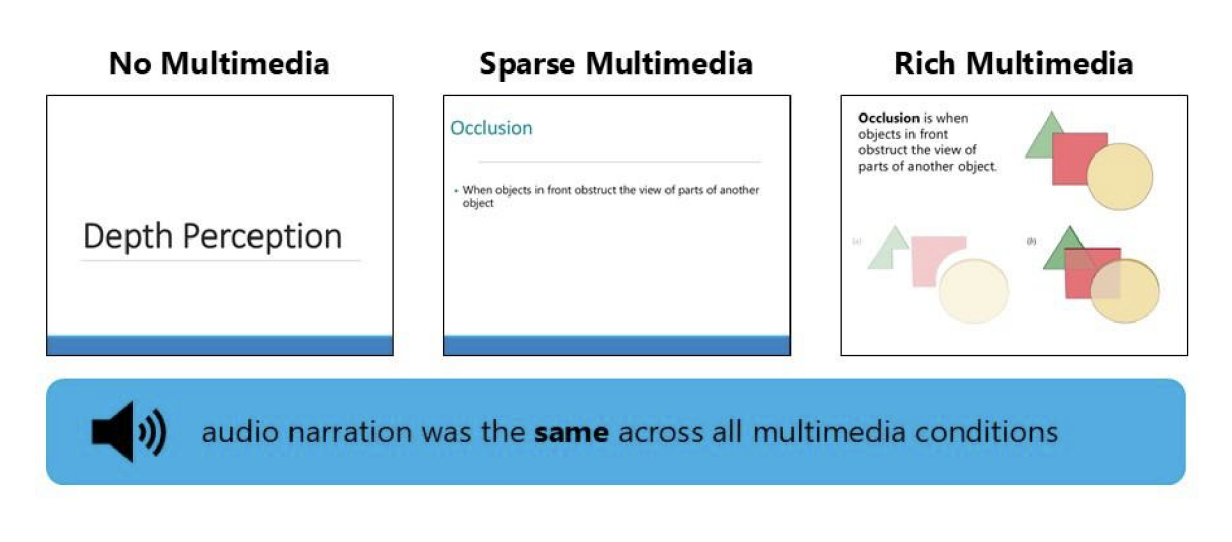
It is important to note the study design. We held the narration constant across all three
multimedia conditions. This means that the audio lecture was the same, regardless of
the slides shown. The same person designed the content, wrote the script, and narrated
the lecture. Perhaps, this overrides any influence slide design would have had on
learning.
For multimedia to be effective, design elements, like images and bolded words,
organize learning material in a way is easy to understand (Mayer, 2009). If the style of
teaching already achieves this, additional organization through multimedia may have no
effect on learning. We summarized this idea through the Instructional Equivalence
Hypothesis: if the lecture itself was well-paced, engaging, and enjoyable, the quality of
the slides may have little measurable impact on learning.
So, what does this mean for you? Maybe there shouldn’t be as much pressure to create
beautiful, aesthetically pleasing presentations. Instead, the focus should be on the
quality of the content itself. Are you structuring your content in a way that is easy to
follow? Are you using examples when appropriate? Are you engaging? All these factors
may be more important than the slides alone. As you prepare for your next presentation
in school or work, remember that not everyone has to become a master content creator.
Focus on enhancing the content in ways that work for you and your audience.
If you enjoyed this blog post, check out our other blog posts!
References
Mayer, R. E. (2009). Multimedia learning (2nd ed.). Cambridge University Press. https://
doi.org/10.1017/CBO9780511811678
Schmidt, K. J., Dukewich, K. R., Symonds, C. I., & Thrasher, A. V. (2025). When more
isn’t better: Evidence for an instructional equivalence hypothesis in multimedia design.
Frontiers in Psychology, 16, 1718397. https://doi.org/10.3389/fpsyg.2025.1718397
Staneviciene, E., & Žekienė, G. (2025). The use of multimedia in the teaching and
learning process of higher education: A systematic review. Sustainability, 17(19), 8859.
https://doi.org/10.3390/su17198859
Disclaimer
The blog posts are for informational and educational purposes only. The posts should not be considered as any type of advice (medical, mental health, legal, and/or religious advice). All blog posts have been researched, written, and edited by the undergraduate students and alumni of the Lifespan Cognition Lab. As a teaching and research-based lab, we encourage all lab members to help make knowledge more accessible to all communities through these posts.